
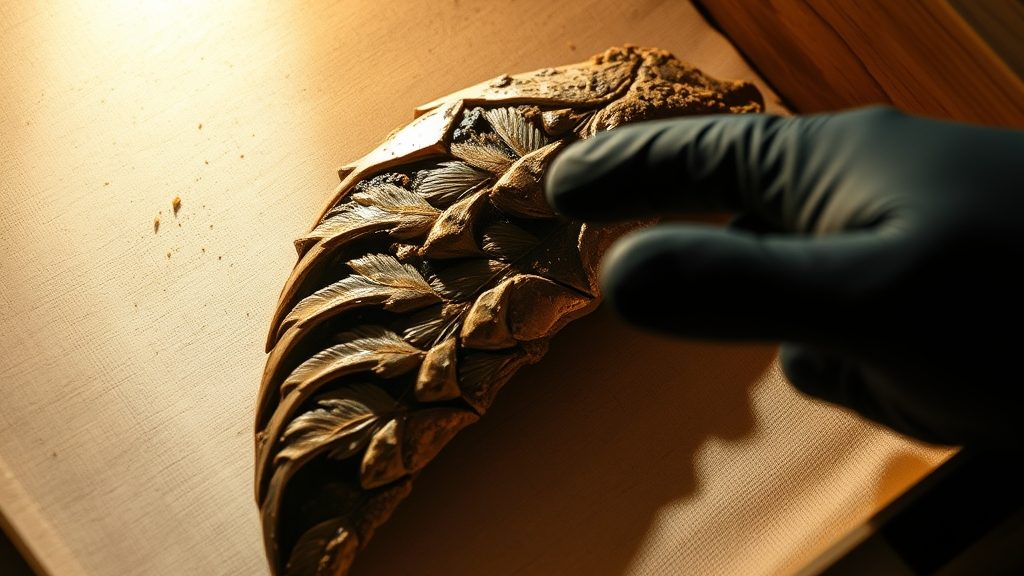
For nearly a century, a chunk of a fossilized skull sat forgotten in a Natural History Museum drawer, waiting to be recognized as one of the most significant finds in recent years. This creature, Invictibellatrix amberina, represents the first megaraptoran ever discovered in Europe, providing a missing link in the history of these agile, two-legged carnivores.
The identification of this dinosaur is a milestone for understanding the Early Cretaceous period, roughly 120 million years ago. While researchers have long known that the Isle of Wight serves as a treasure trove for paleontological remains, the fact that this specific bone remained hidden since its acquisition in 1924 highlights the untapped potential of existing museum collections. This discovery proves that the next major breakthrough in dinosaur research may already be resting in a storage facility.
Lead author Dr. Cassius Morrison of University College London and his team used CT scans to create a 3D model of the skull fragment, comparing it against various theropods like tyrannosaurs and spinosaurs. Their findings, published in the journal Royal Society Open Science, suggest that this predator was about three to four metres long and stood over a metre and a half tall. Unlike the massive Tyrannosaurus rex, which might have considered humans too small to hunt, this tiger-sized carnivore would have likely viewed a human as perfectly sized prey. The dinosaur, whose name translates to "unconquered female warrior," likely possessed feathers and utilized giant, curved claws measuring up to 20cm to hunt small dinosaurs, lizards, and mammals.
As experts continue to study the remains, the discovery confirms that megaraptorans were not limited to other continents, fundamentally shifting current knowledge of their geographical spread and evolutionary history.